

Interview #16: Tom Shepherd
Artist, Teacher, Surfer

Dear friends,
If you’re new here, my name is Jo and I write ‘The Travelling Artist’ newsletter, where once a month, I share an interview with an artist I’ve either met or admired from afar.
I am nosy.
I like nothing more than talking ‘shop’ with other artists, hearing how they work, what’s influenced them, their favourite tools, and looking around their workspaces.
Every artist is given a list of questions and they get to choose which ones and how many they answer.
These are free to read, and if you enjoy them, please consider subscribing, sharing and commenting.
In this interview, I’m delighted to welcome, Tom Shepherd, I was drawn to his work from the moment I first saw it, from the instinctual mark making to the bright colours, I can;t think of a much better description than ‘it sparks joy!’.
I need to be a bit careful here as I’m such a big fan, I’ve been on two of his art retreats, with two more in the pipeline, I’m a member of his online watercolour school and if I carry on this is just going to sound like one massive advertorial!
This one definitely requires a cuppa. Here we go:
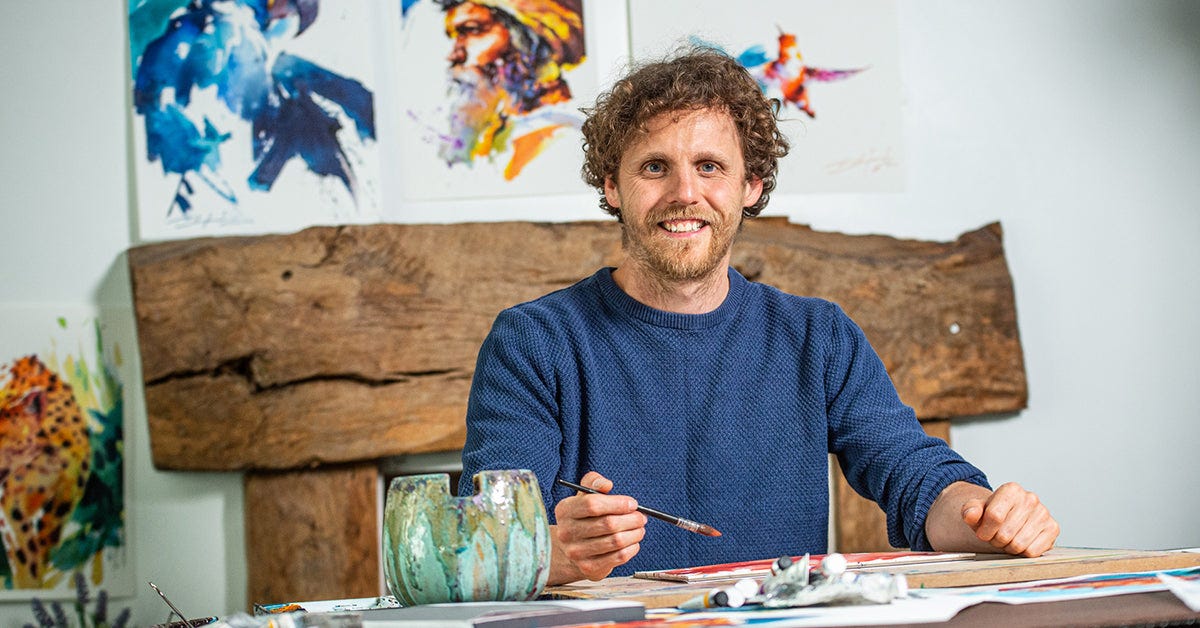
Tom Shepherd
1. Can you give us a brief introduction to yourself and your work, what your primary art form is, and how long you’ve been creating?
My name is Tom, and I’ve been a full-time artist (making a living from my art one way or another) since I was about 22… so nearly 20 years now, which still amazes me. I live tucked away in the depths of the rugged Pembrokeshire coastline in Wales — a place I truly love.
I’m very grateful to have a good-sized studio just a short walk from home.
I started out using Posca paint pens on pretty much everything — surfboards, motorbike tanks, skateboards, musical instruments… anything that would hold still long enough.
For a few years I focused almost exclusively on painting guitars, both to commission and for larger companies.
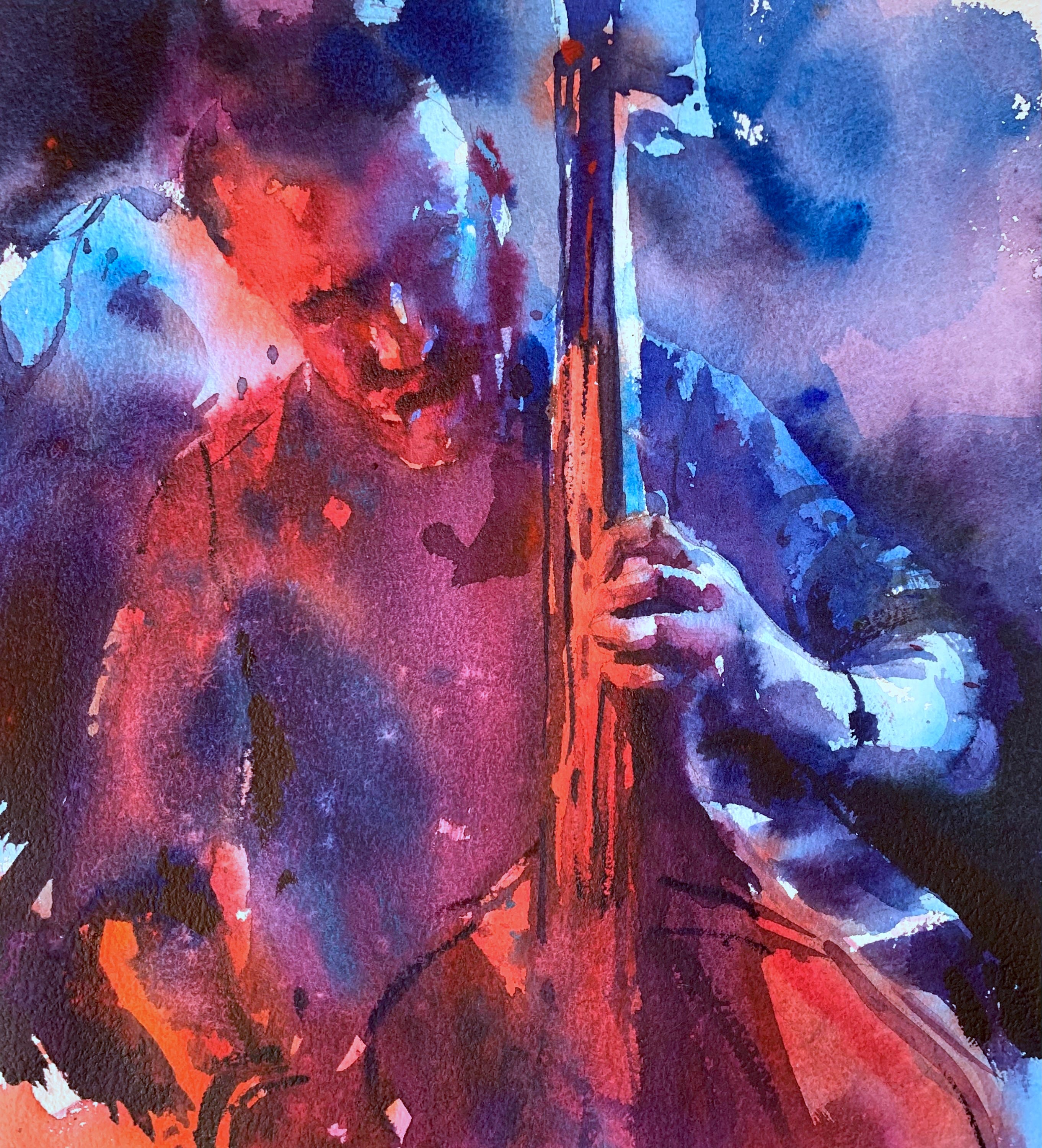
From there I moved into oils, through acrylics, and eventually into my most long-standing medium, and the one I’m probably best known for, watercolour, which really jump-started my career as an artist.
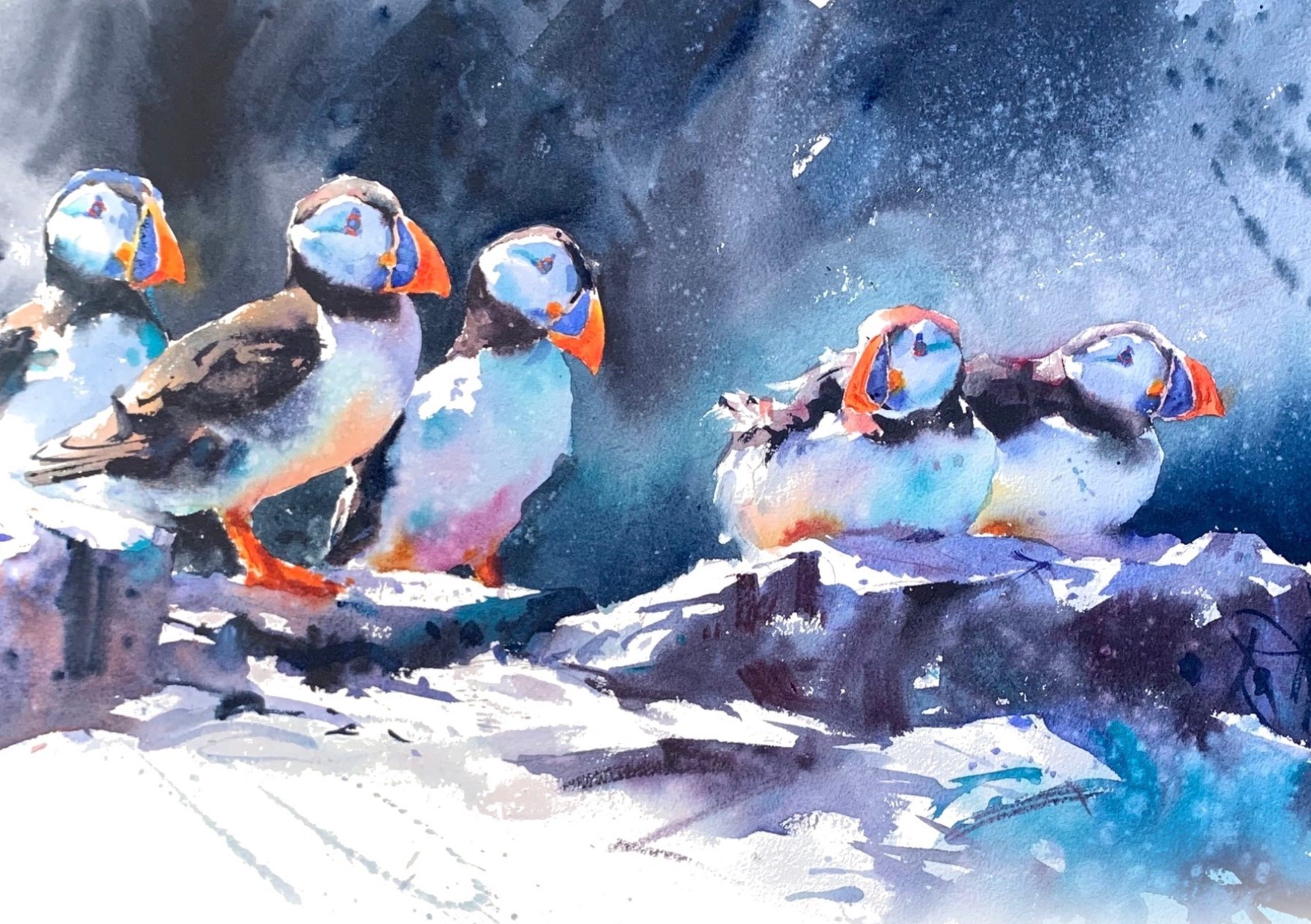
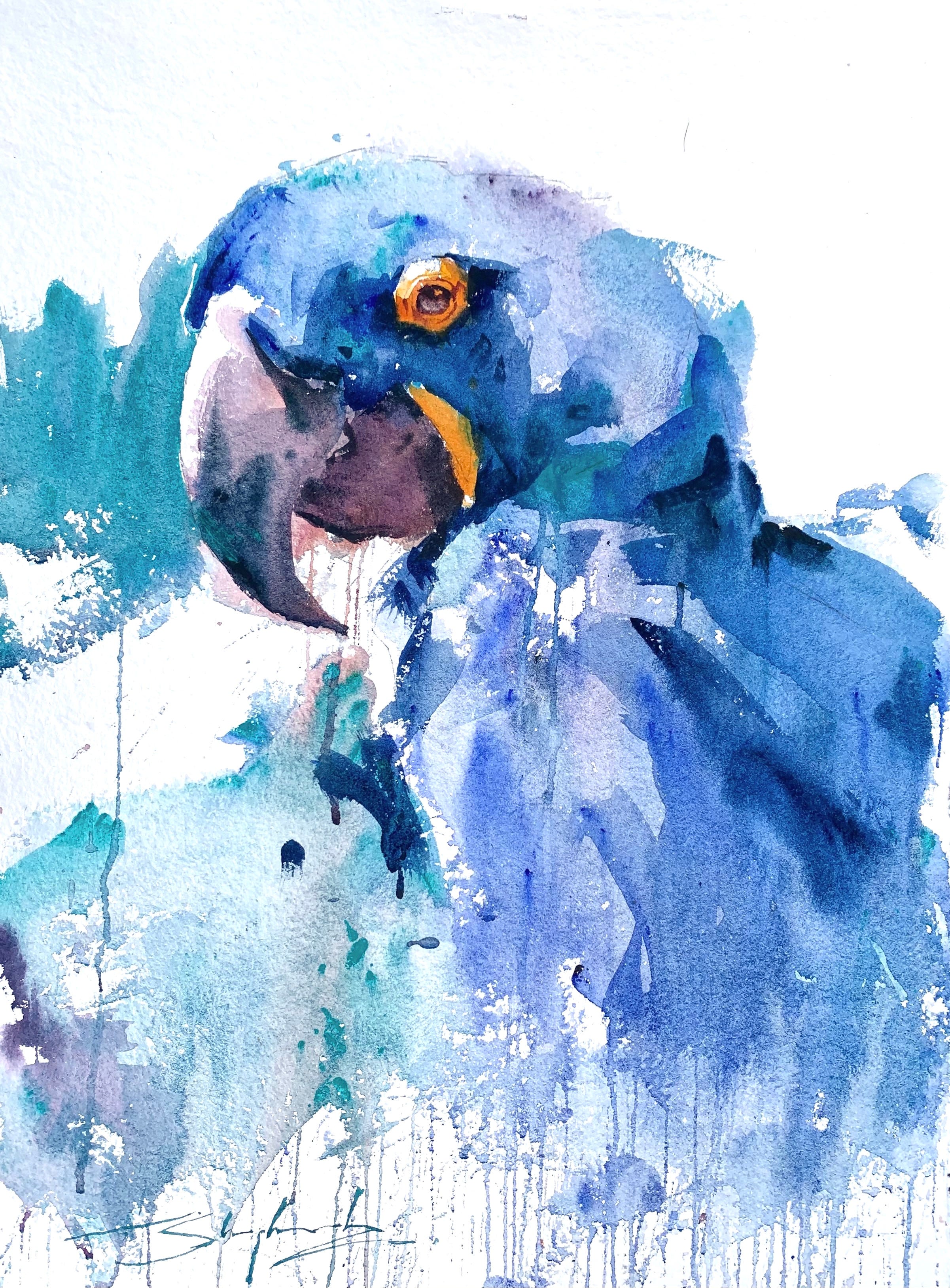
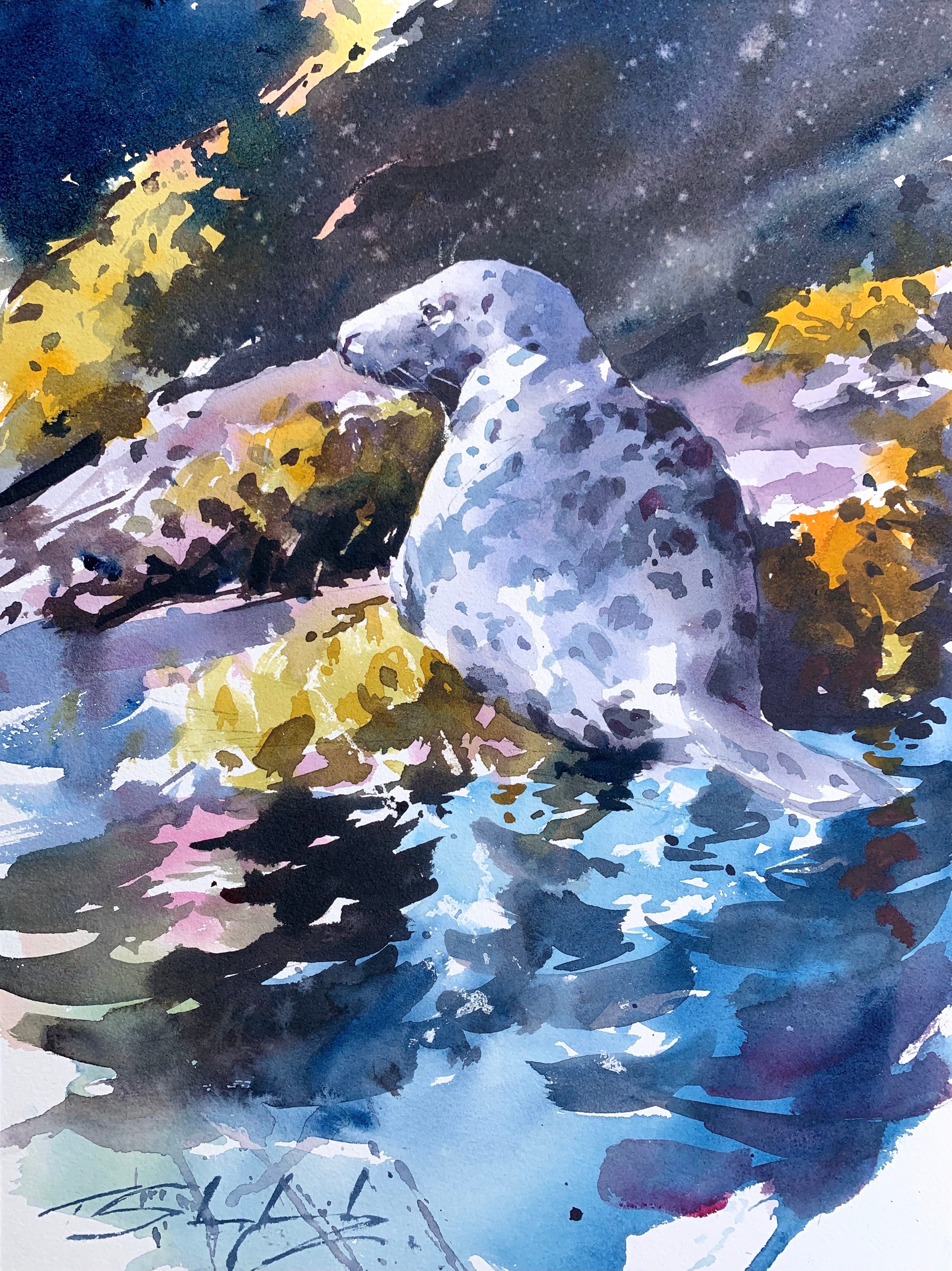
I’m probably best known for my wildlife work (and yes, I’m biased), but honestly I love painting everything; Coastal scenes and landscapes, streets, still life, and of course people — whether informal portraits, figure painting, or musicians. Any excuse to get the watercolours out really!!
2. How would you describe your artistic style and the themes that most inspire your work?
Oh definitely; too many to mention really!
It’s a bit obvious I know, but first seeing John Singer Sargent and Zorn, once I moved into oils, was hugely influential. It really set me off into the world of representational painting and more traditional mediums and approaches.
The core principle that stood out for me was the physical use of paint itself; the brushmarks, the illusion of a subject from afar, yet up close it almost just looks like a mess (my exact words the first time I saw these paintings in the flesh, ha!). I think now I’d call it painterly.....I became obsessed with that concept.....and I suppose that’s very much at the heart of the Impressionists too, giving the impression of a subject, not its exact form.
Joaquín Sorolla has become an absolute all time favourite. I saw an exhibition of his work in London a few years ago and stood in absolute awe in every single room.....genuinely mind blown. The scale is one thing, but his use of colour and his ability to capture light.....just incredible.
I also have to directly reference Karl Martens; a bird painter who works in watercolour on huge sheets of paper in a very unique way. Seeing his work gave me permission to paint birds.....in watercolour.....and to find my own way of doing so.
Painting birds on a white background is actually what launched me into watercolour, and from there it has been a full on love affair with the medium. I love the spontaneity and expression it can give.
Now there are so, so, so many incredible watercolourists out there who I draw huge amounts of inspiration from .....so many expressive and wonderfully unique ways of seeing the world and then using the spontaneous, free flowing nature of the medium, paired with its ability to be refined to capture their vision!
It is almost impossible to single out names.....but I have to say when I first saw Álvaro Castagnet’s watercolours it gave me permission to be bold, dynamic, less literal, to really play with colour schemes, and to be quite rough and raw in the way I use the medium. A key moment.
Culture wise, I’ve always loved to travel, and art and travel make incredible companions. I love painting landscapes, people, and wildlife in the places I’ve travelled.
As an artist, the colours, smells, sounds, and the constantly contrasting cultures of places like Morocco, Kenya, Nepal, and Tibet have really stayed with me; they sit deep in my mind and heart. I keep coming back to those subjects, so they’ve influenced my work in more subtle, underlying ways.
I could list many movements.....hundreds, thousands of artists.....but the above are a handful that have been real pivot points in my own work.
(PS I love charcoal, and use it more and more outside of watercolour.....there are some wonderful artists there too, obviously, but that’s a whole different can of worms!)
3. How would you describe your artistic style and the themes that most inspire your work?
I am always intrigued by trying to work loose and painterly, I love looking at a subject in terms of light and shadow shapes and using that as the foundation to paint shapes, letting them jigsaw together in the eye to give that impression of my subject.....that’s the heart of my artistic aim if you want to call it that.
Brush marks and strokes are never hidden, they are part of the language of the painting and I’m always interested in how abstract and loose I can go before it all falls apart.....that edge where it still reads, still feels believable, but is clearly just shapes, marks, and washes...
The shapes of tone that make up the subject become places to play with the paint, the colour letting the paint flow and run and do its thing.....increasingly texture plays a big role too, letting the surface breathe and stay alive rather than overworked or tight
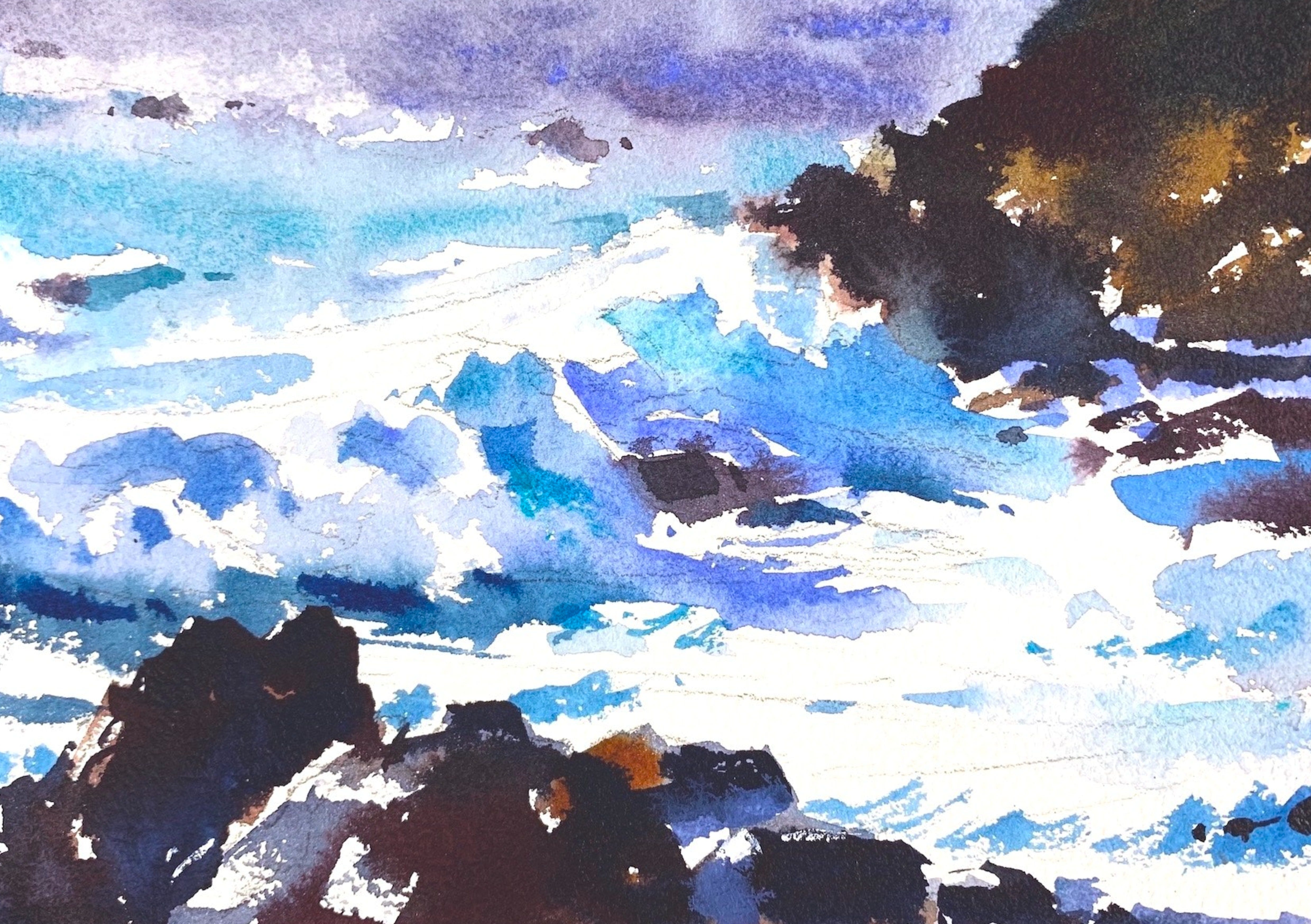
Light and shadow are probably the biggest underlying themes in my work. Tone comes first for me.....everything hangs off it. I’m far more interested in capturing the feeling of light, movement, and energy than describing every detail. Whether it’s wildlife, coastal scenes, streets, or people, I’m always looking for that moment where the light gives the subject its character, its rhythm, its sense of life.
A big part of my approach is working with the watercolour rather than trying to dominate it. I like allowing the paint to have a say in the outcome.....letting washes move, edges break, colours mingle. I’m not chasing control for its own sake, more a balance between intention and letting go. That unpredictability is what keeps the work fresh and exciting for me.
One buzzword that becomes increasingly important to me is simplicty. How simply and to the point can I make a painting. How much can I leave out and still say what I want to say? A question I ask myself alot!
Ultimately I’m never trying to make an exact copy of what’s in front of me. It’s always an interpretation.....my response to a subject rather than a literal record. Using paint to give the impression of something rather than explaining it fully. I want the viewer to feel the subject, not just recognise it, and for the painting to stay open, expressive, and full of energy rather than resolved and closed down.
4. Can you describe a typical day when you are working?
Far too much admin.....the end! Ha
It’s quite hard to give a typical day, because each one is extremely different. Between kids, home life, working around my partner’s schedule (particularly as our eldest is homeschooled), and the sheer variety of work I do, no two days really look the same.
My work includes teaching in person, teaching online, running a watercolour school, commissions, all the admin that comes with this, writing books, articles, blog spots, youtube, social media (all though I’ve cut down on this a lot!)and of course trying to squeeze a surf in at least a couple of times a week. Each day is different, even week to week.....
....oh yes, and I do try and do some art in there too (see how easily it falls to the bottom of the pile).
So I’ll give you more of an overall view instead.
One thing I genuinely love is that every day is very different. When I first started, I was very attached to the romantic idea that I was an artist and that structure and discipline would somehow ruin my creativity (ha.....what a diva).
Over time I swiftly learnt that discipline and organising your time actually creates little containers for creativity, and within those you can be far more productive.
I’m not going to pretend I’m naturally organised, or that I’m always on top of everything. But over time I’ve learnt skills to manage my time, my space, and my workload, and that has been absolutely key for me. Particularly with a young family to support and actually spend quality time with.
This year, 2025, I’ve even taken on a few small bits of side work managing YouTube channels for other people, writing scripts, and a bit of video editing.
I’ve really loved it. I needed a little step back, a little financial pressure off the art and the business, and a bit of a reset.....and it’s done exactly that. I feel re-energised about both my art and my business.
In the past I’ve slipped far too much into obsessing over getting on top of all my admin, which is an impossible task. And also spreading myself far too thin across too many areas of my life and my business, to the detriment of both the business and my own health.
So these days I consciously focus every single day on balance and retaining a certain level of peace.....admin, time with kids and family, staying on top of what needs to be done, but also making sure there is time to play. For me that means music and surfing.
At the moment, writing this as we head into the start of 2026, that balance is working really well.
I’m also interestingly putting absolutely no pressure on the painting itself, or even on making painting sales. I’ve spent many years building additional art related income streams, which allows me to do that.
So I’m playing in my sketchbooks, painting and doodling whatever I want.....and genuinely I’m loving my painting more than ever because of it.
This approach also fits really well with a not overly structured, but well time blocked lifestyle, which seems to suit both my work and my life perfectly.
Like my art, I’m aiming more and more for simplicty as my buzzword!;
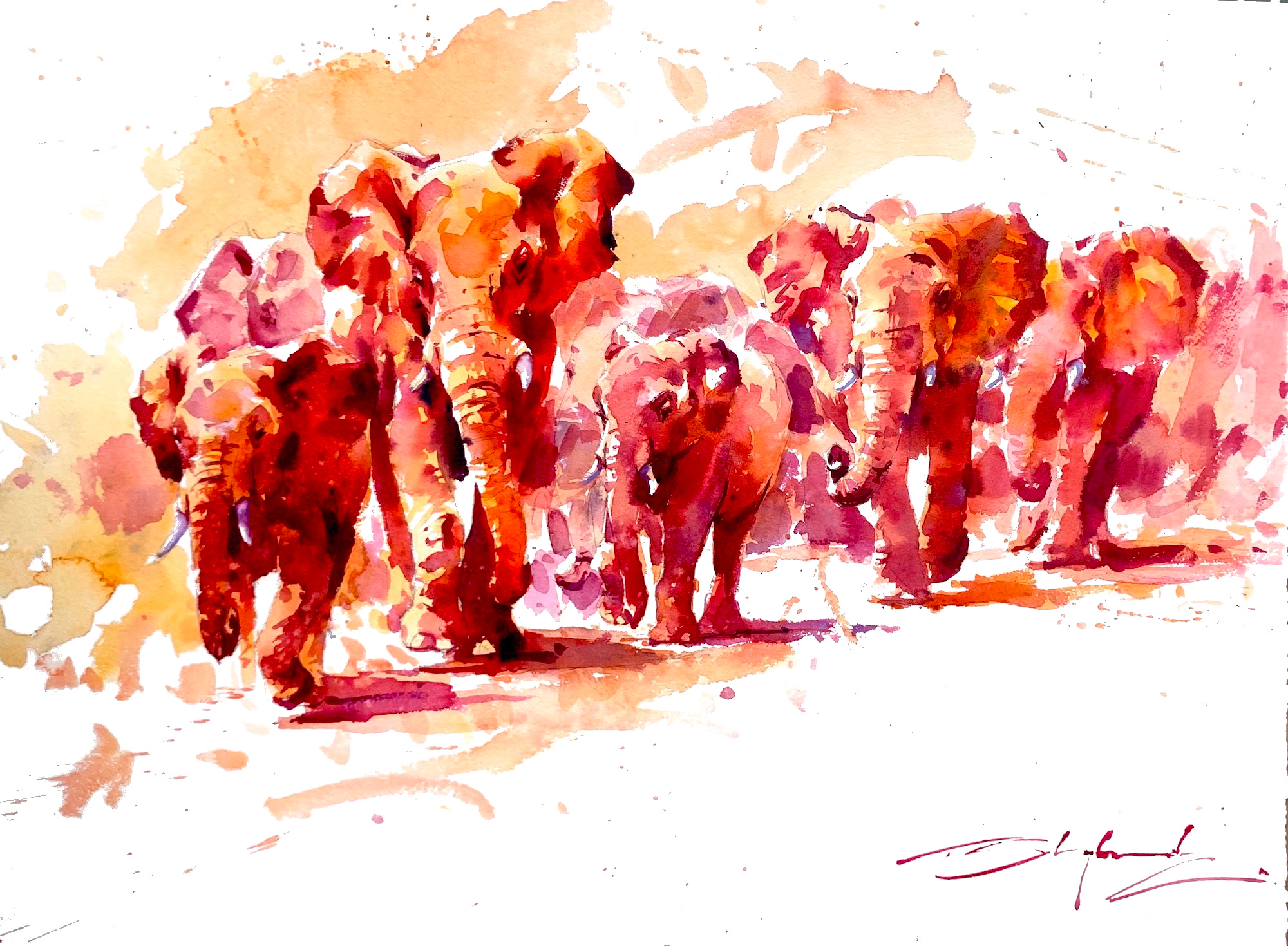
5. Can you describe your physical workspace or studio environment and does it influence your creative process?
An absolutely unusable tip.....because right now it is.
But that’s only because I’ve just moved studio. As I write this I’m literally sitting in my new studio surrounded by piles of boxes and all my stuff (which I’ve just brutally trimmed down.)
Having had so many studios of all types over the years, from the corner of a tiny bedroom to a freezing cold barn, and doing a lot of painting and teaching in all sorts of random venues and spots, I’ve learnt that as long as I’ve got room to put things out and sling a brush around, I can actually paint anywhere.
Whatever my surroundings I don’t find it hard zone in. That’s something I’ve learnt out of necessity, but it’s been a real benefit, as I don’t need perfect conditions to paint.
That said, of course the space, and in my case a studio, can have a wonderfully positive effect on the creative process.
Having different areas for different tasks, especially now I have the space in my new studio, is really key for me.
There’s a painting area, a teaching and filming area, an admin and office area, and space for packing and practical work.
I’ve had so many tiny studios in the past where I was constantly changing the purpose of the same space all the time, and that takes so much energy and can become a real block to creating.
I suppose that’s the main takeaway for me. My studio needs to feel good, and feel like I can step in and there are no physical barriers to creating.
Don’t worry, I’ll still come up with a hundred reasons to procrastinate actually doing some painting, but at least if I remove all the physical obstacles, I stand a fighting chance.
I also really like simplicity and a lack of clutter.
I’m actually not a chaotic storm of creative madness with stuff everywhere type artist (I reserve that kind of disorganised mess for the cupboard no one’s allowed to look in).
In the studio I like everything to have a home. It doesn’t have to be perfect, it can be rough and ready with signs of use, but I like things to go back where they belong.
Unless I’m working on an ongoing project, I also like to clear my actual creating space when I’m done, so when I come back to it next time, it feels open, inviting, and ready to go.
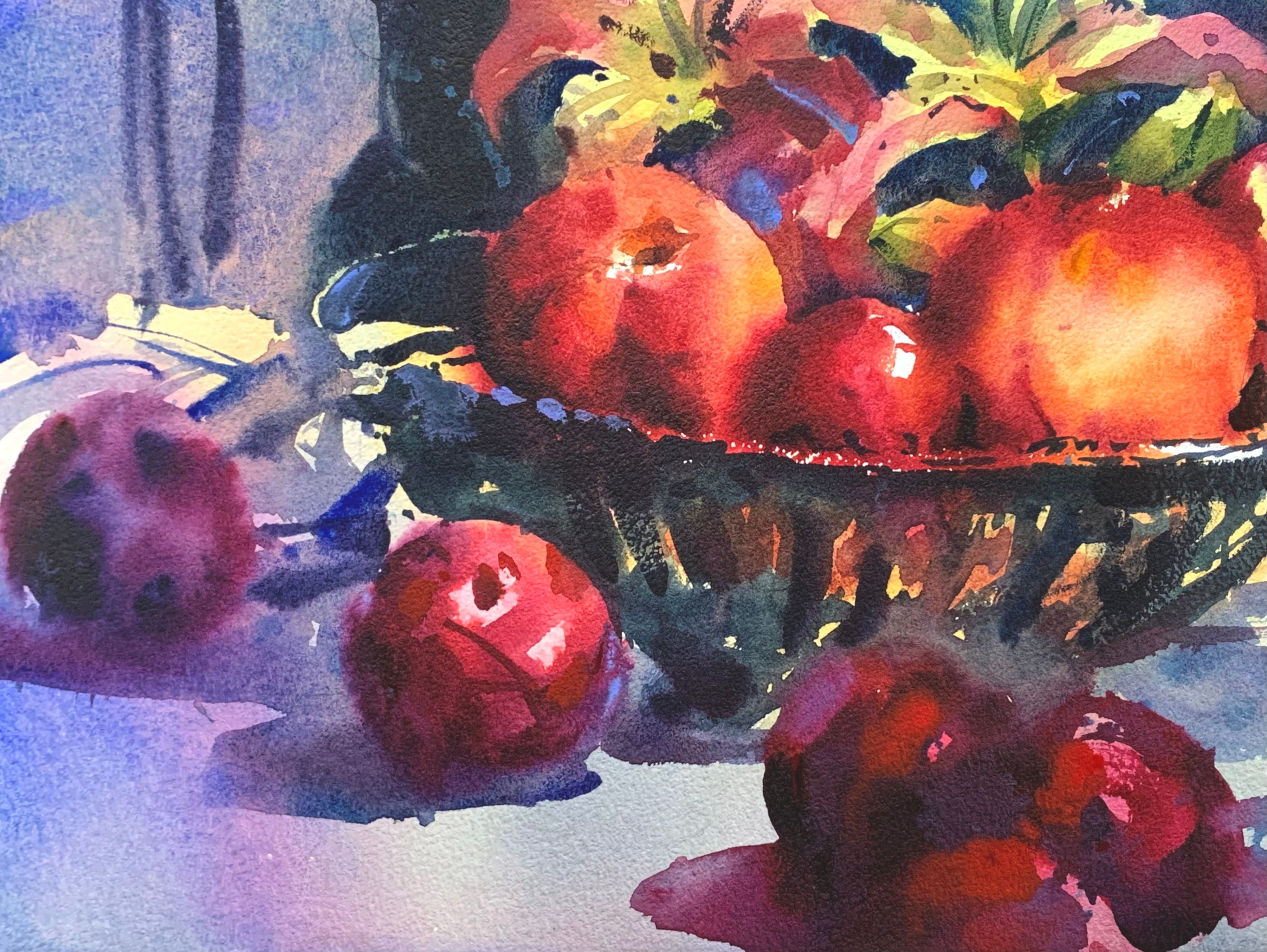
But ultimately for me it’s all about the feel good factor. It’s not just where I paint, it’s where I can be fully myself. A lot of my favourite things live in the studio, from surfboards to musical instruments, to other people’s art, little artefacts, a comfy sofa, cups of tea on hand, and of course all my favourite art materials
.
6. In what ways does the community or cultural environment around you shape your art?
Ooo that’s a good question.
In some ways, physically, I live quite an isolated life as an artist.
Meaning I don’t currently have a huge amount of day to day connection with other artists locally in Pembrokeshire.
That’s partly because we only moved here five years ago, and so much of my work still happens online and through travel.
That said, I can really feel the pull to connect more with other creatives locally, and opportunities are starting to arise. Having experienced that kind of creative community in the past, I don’t think it should ever be overlooked.....those people really are your people.
The cultural environment where I live now is very much centred around a slightly more alternative way of living, and strongly connected to the sea, surfing, and being in nature as much as possible.
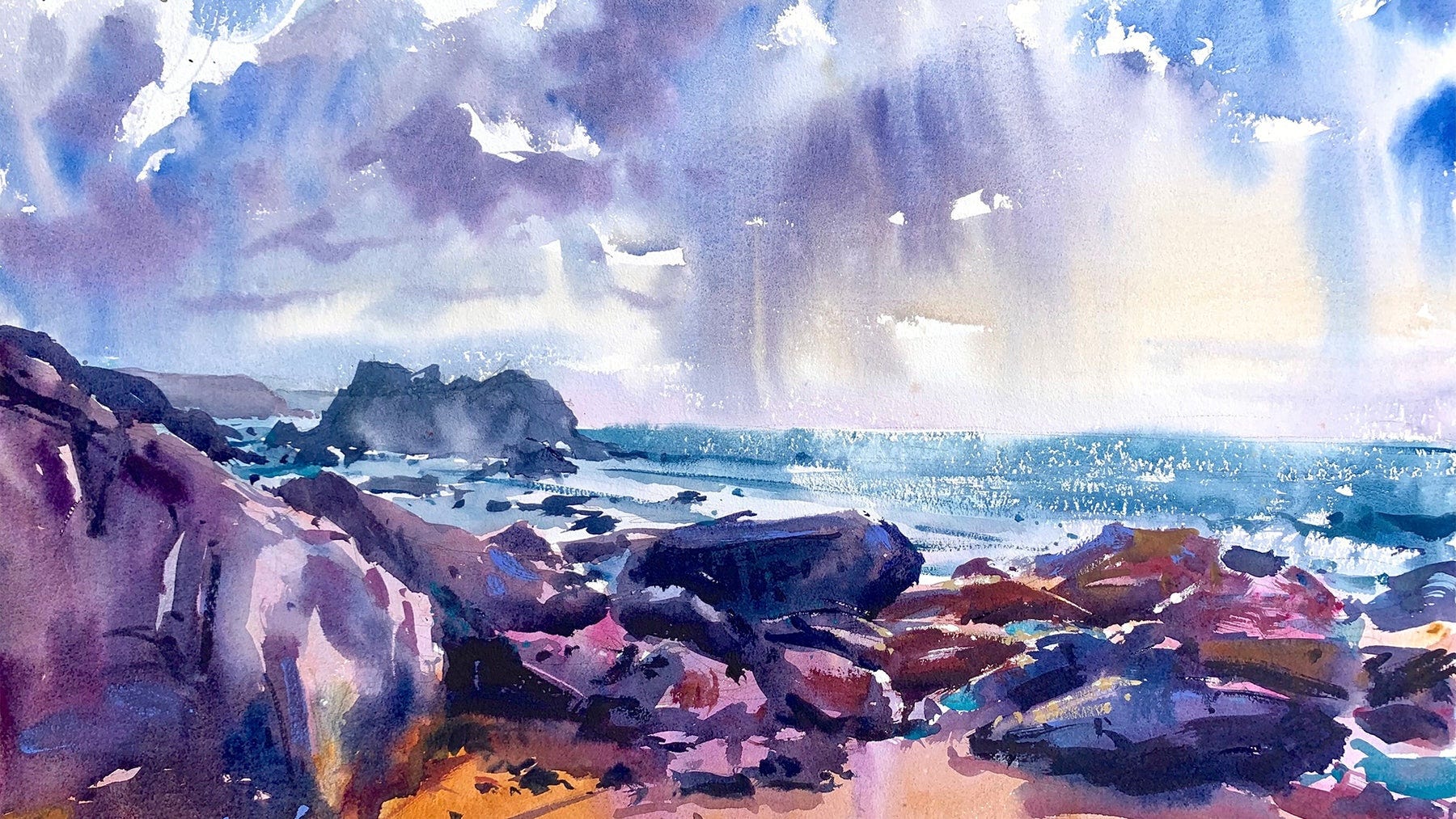
That lifestyle directly influences my work. I love painting Pembrokeshire.....its rugged coastline, the land, the sea, and the constant movement and mood of the place.
It’s also easy for me to forget, because it’s been my life for over twenty years, that my entire working world is made up of creative people.
Through my business I’m constantly surrounded by artists.....online, in person, through travel, teaching, and ongoing connections. I exist in that creative world all the time, and I love it.
Sometimes I forget that not everyone gets to live like that.....which is a real privilege to be able to say.
And whilst, as I said, I don’t necessarily directly connect with other artists every day in person (even though online I do all the time), all of my close friends are creative in some way too, even if they’re not doing it as much as they’d like.
So perhaps I do take it slightly for granted because it’s always around me. Regardless of whether it’s online or in person, I have an incredible network of artists that I know and stay in regular contact with.
None of this necessarily affects my artwork in a direct, obvious way, but in many ways it’s more important than that. It’s my support network. Like minded people to share the ups and downs with, to bounce ideas off, and to feel understood by.
More than almost anything else in business and in art, I think this is one of the most important things. Connecting with and valuing other artists and creatives. They are not your competition.....they are your community! And that is crucial.
I’m also lucky enough to travel and teach, which really scratches that itch for travel and cultural variety, and that influences my work a lot.
Alongside online and in person teaching in the UK, it means I’m constantly meeting new people through the common thread of art.
It doesn’t really matter whether it’s student to tutor, its actually just or artist to artist, whatever your ability level.....we’re all just people coming together to paint, and that is something I find genuinely wonderful.
Being an artist for me is still about my own journey and my own work, but increasingly just I find as much, if not often more joy, in sharing it with others and helping them develop their own art.
Being “in service” sounds a bit over the top and self-important ha...so....perhaps a better way to put it is actively contributing to the wider creative community in a meaningful way. That, more than anything, feels like what it’s really all about.
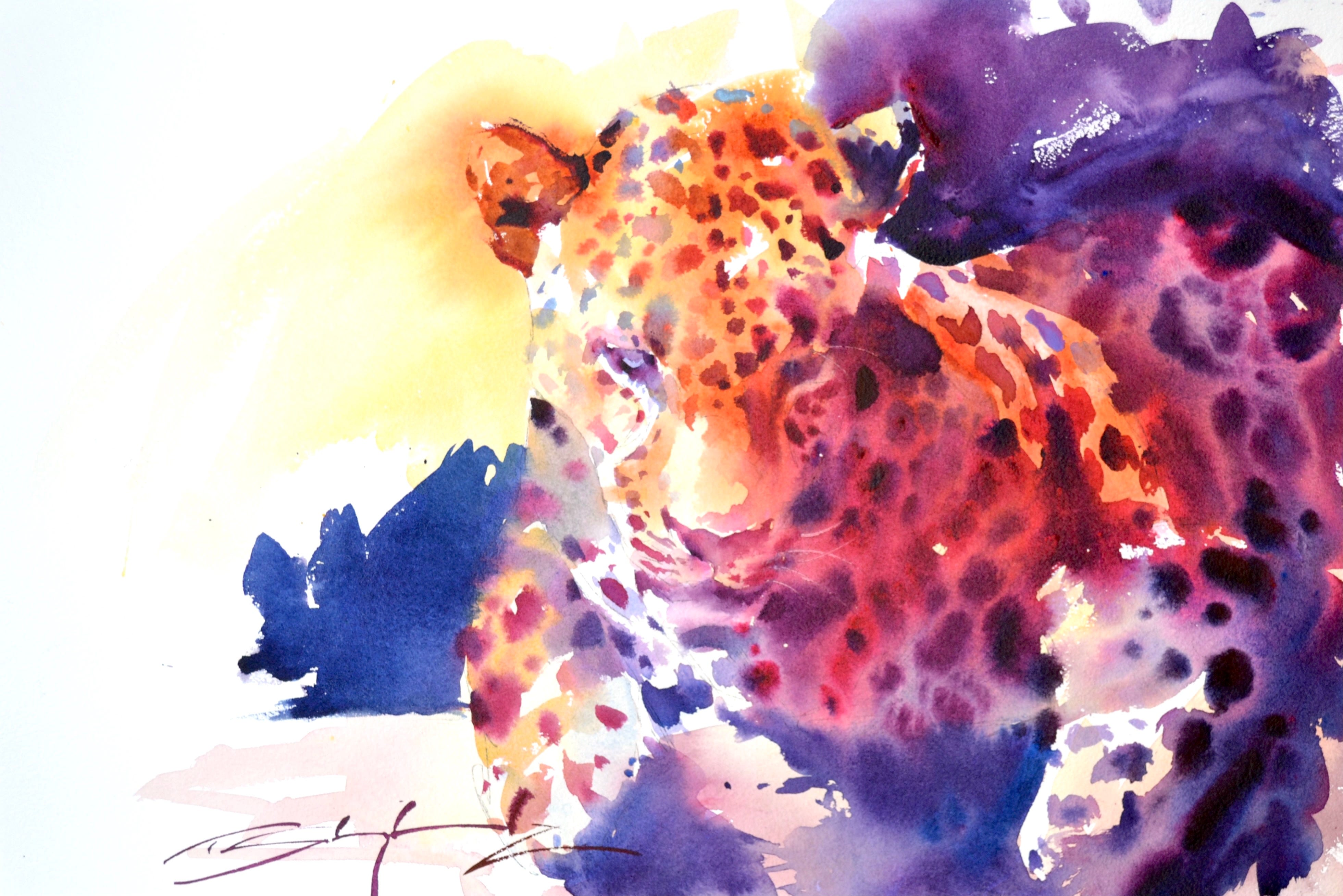
7. What impact do you think current global or local issues have had on your recent work?
Hmm, that’s such an interesting question.
The world feels incredibly small now, in terms of how much we know and how deeply affected we are by everything going on globally. It would be unrealistic, and very privileged, to think we are not affected in some by both local and global issues and can ignore them.
So where does that leave us as artists?
Do all the things I see on the news and everything happening in the world directly feed into my art? No not at all, at least not in an obvious or literal way....
Am I making bold political statements with my work? No.
Should an artist be doing that? I’m honestly not sure. Possibly. But the art I feel most called to make isn’t that, and that doesn’t mean I’m ignoring what’s happening, it just shows up in other areas of my life rather than directly on the paper.
That said, I have always used my art as a way to raise funds and support projects and causes I feel are important.
It’s incredibly hard to know where to focus your attention and your ability to make positive change, however small or large, whether closer to home or further afield. I’ve tended to naturally focus on environmental elements, partly because my art owes so much to the natural world.
Over the years I’ve donated percentages of exhibition sales to wildlife conservation causes, including organisations like the David Shepherd Wildlife Foundation, Wildlife and Wetlands Trust (an often overlooked ecosystem that is crucial), and Surfers Against Sewage (might sound like a lightweight organisation, but they’ve brought about incredibly significant change here in the UK, particularly in holding companies, including water companies, accountable for sewage pollution in our rivers and coastal ecosystems.
There’s also a local organisation here in Pembrokeshire doing amazing work around developing the use of seaweed to help manage water quality and marine ecosystems, which feels especially easy and meaningful to support because it’s local.
One project I’m particularly excited about, which is slowly gaining momentum, was born by a good friend of mine, Martin Aveling.
It’s about bringing art related opportunities to financially poor rural communities in Kenya.
If you’re reading this, you’ll most likely already know how important creativity is for mental health, confidence, and personal development.
The phrase children are our future is a cliché, but it’s also very true. There are various deeply researched brilliant book importance of creativity in children, particularly in terms of confidence and connection to the world around them.
It’s easy for us to take for granted how simple it is to grab a piece of paper and a pencil and draw, but for so many people that isn’t remotely an option.
We could focus on many places around the world, but due to existing connections we’re currently focusing on rural communities in Kenya. This is partly because there are already some incredible initiatives empowering local people there, particularly local women, and because wildlife conservation cannot be separated from humanitarian issues and the wellbeing of local communities.
And so our goal is bringing art to children who don’t have access to creative opportunities, as a means of building confidence, personal growth, and helping them connect with and care for their environment and the wildlife around them, ticks so many boxes for both me and Martin.
So far we’ve funded shipping containers converted into art hubs, and just as importantly, helped to keep those hubs running with new art materials. I have run two extremely successful Zoom Courses to raise funds as well as donated percentage of certain painting sales.
We’re now looking at sending artists out to run weekend workshops for children and the wider community, as well as exploring the idea of creating digital lessons, possibly through my school, that can be projected into these creative hubs for both children and adults to create along with and learn remotely. That feels incredibly exciting.
I think it’s very easy to become overwhelmed by the state of the world, to feel helpless, or to feel like we should be doing everything, everywhere and end up paralysed.
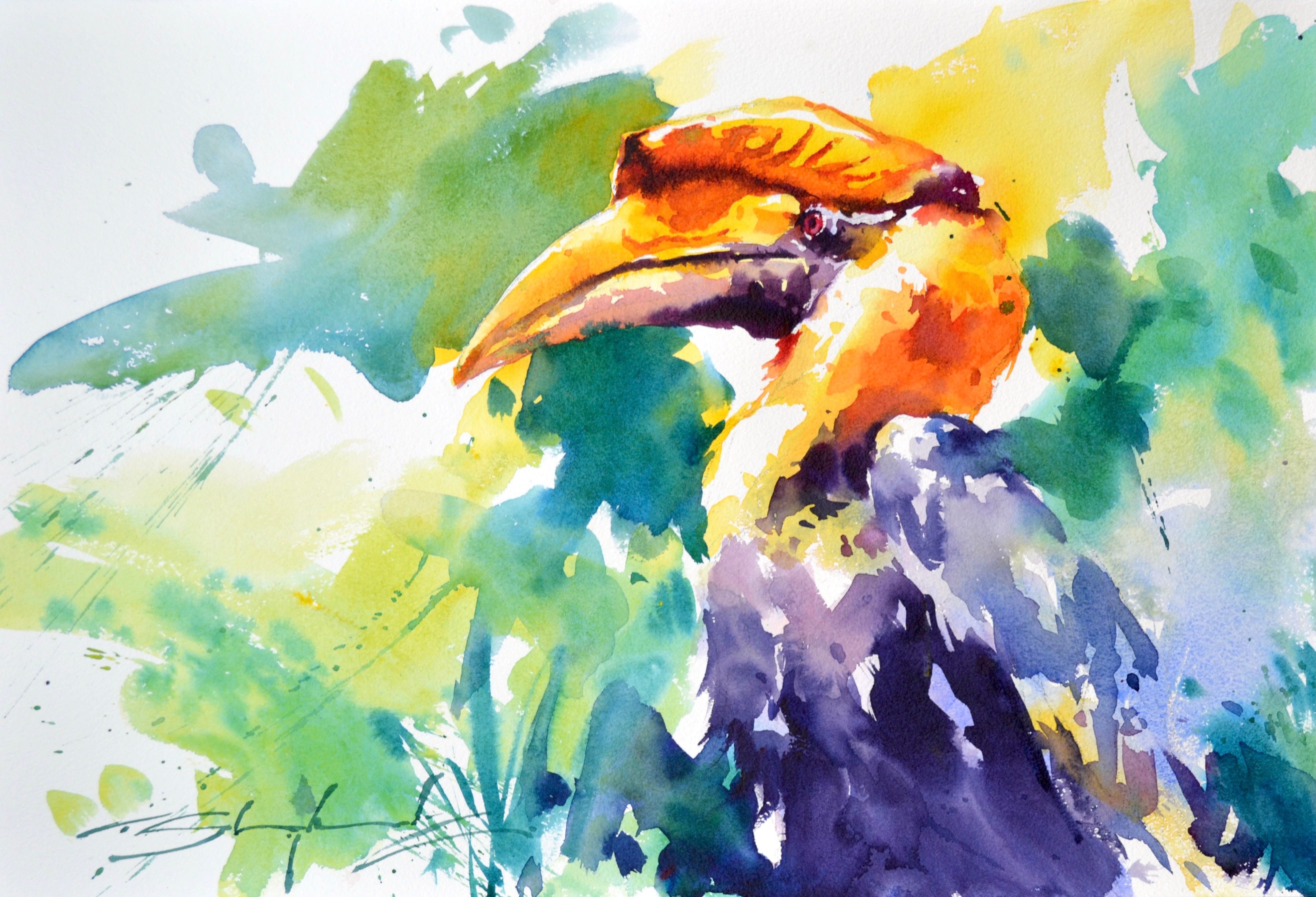
I’ve chosen to take the route of using the monetary side of my art, and the platform I have, to support causes that feel close to my heart, both physically and emotionally. It feels like a way of contributing that is honest, sustainable, and meaningful for me
.
8. Can you walk us through your typical creative process, from idea to finished piece?
I don’t actually have a particularly deep or complicated creative process. It’s really born out of twenty years of constantly thinking about art, a huge amount of self study, and a lot of practice. The actual in the moment process is simple and fairly quick.
My main focus is always light and shadow, and spotting opportunities to have fun with the medium. That’s my core MO.
Colour excitement, and playing with soft and hard edges, come a close second, usually developed during the painting.
Detail, if it appears at all, is usually something I only think about right at the very end of the painting.
Working outdoors is a different rhythm, but in the studio I usually work from photos.
Sometimes they’re my own, sometimes other people’s, sometimes a mixture of both.
Sometimes I use photos purely as a jumping off point, sketching out my own idea based on them and pulling in other references if needed.
Other times I work from a single photo more directly, though I’m always tweaking composition, editing things out, exaggerating shapes, or pushing areas as I see fit.
Increasingly, my initial drawings have less and less information in them, because I like to discover the subject during the painting process. Even when I do make a drawing, I don’t hold myself to it too tightly. I always leave room to deviate.
I might start with a rough goal in mind, but most importantly I’ve already studied the subject in terms of light and shadow. Where is each, is there a focal point, where are the points of interest, where can I simplify or even go fully abstract. I ask all these questions.
I’d love to pretend I plan everything, but in reality unless a piece is very complex or large, I don’t overthink it. I ask enough questions to get started, and then I paint.
Painting for me is a beautiful blend of analytical thinking and spontaneous creativity, and my brain seems to love that balance. It also seems to enjoy the very intense nature of wet into wet kind of one-hit watercolour painting, with its minimal planning and the way it forces you to make decisions within the timing the medium demands.
It’s a bit of a wild ride. You start here, aim roughly over there, think you know the route, and then watercolour says no, you can’t go that way. Oh, and that end goal you had in mind, I’ve got different ideas. And that is exactly what I love about it.
So the process is setting up, getting grounded, asking a series of questions to form a loose direction, and then jumping on the rollercoaster.
Watercolour tells me when to stop, so I do. Usually 10 minutes later than I should have done!
The result then usually falls into one of three categories.
It goes in the bin as another complete disaster that can’t be rescued.
If I’m really lucky, and very rarely, it goes straight on the wall to live with for a bit.
Or most likely, it sits in a maybe pile not looked at again for quite some time, then pulled out and a decision made when I have no emotional attachment to it any more because I forgot I even painted it! (most paintings look better from this place)
9. Have you had any challenges in pursuing a career as an artist, and how have you overcome them?
Ultimately, I chose this as my career, so I needed to make it work financially.
That has been extremely, extremely hard. My art has suffered at times because of it.
I’ve taken many dead ends and wrong roads, made bad decisions, and put huge amounts of energy into completely the wrong places. But I’ve learnt, and refined.
Over time I’ve developed a much better mental understanding of how to make decisions, and also a much deeper intuition about ideas and opportunities. Slowly but surely I’ve found myself putting my time and attention into the “right” areas.
In all honesty I have increasingly found that “hustle” exhausting. Constantly coming up with new ideas and then executing them, both artistically and from a business point of view. As of yet I haven’t been able to sit back on my laurels and cruise.
That said, as long as my life is in balance, I actually like this way of working. The necessity drives me. I genuinely love brainstorming, coming up with projects, ideas, courses, new opportunities, and then making them happen. That entrepreneurial side of things is something I enjoy....
therefore.....the real challenge is not so much the constancy itself, it is keeping the balance so that all aspects of life remain fulfilling overall. Otherwise it isn’t sustainable. Things fall apart, I burn out, and something suffers somewhere. Another skillset I’ve learnt over the years.
So managing everything has probably been the biggest challenge.
The art itself has its own frustrations. The ups and downs, the moments you want to give up, followed by moments where you think this is exactly why I love it. Often all within the space of twenty minutes of painting, ha. That in itself is a challenge.
But after twenty years I’ve learnt that the reality of both my painting and my business sits on a gently upward baseline, with erratic peaks and troughs either side.
Knowing that has been a wonderful thing. It brings perspective. And with that comes a growing sense of simplicity and peace, which I seem to keep going on about don’t I!?
My relationship with money has also been a huge challenge. A constant fear and worry at times about not having enough to support my family has been overwhelmingly stressful over long periods.
Learning to reframe my thoughts around lack has been crucial, and it’s still ongoing. Putting systems in place, thinking and planning well in advance, while still leaving room for spontaneity and changes of mind, has been vital. So organisation again plays a big role.
As does balance. Planning and being organised, while constantly making small pivots in new directions, tweaking things, trying new ideas, growing and expanding without overstretching.
There’s a lot of slightly airy fairy, less tangible stuff in that answer, I’m aware.
But I think even if you took a group of full time artists, there’s no one size fits all solution or very specific lesson.
It’s more about overarching principles that can then be tailored to each individual person, their needs, circumstances, and desires
.
11. What’s next for you, are there any new projects on the horizon?
What’s next for me is really all about continuing to simplify. That’s the biggest thing. I’m actively cutting out parts of the business and work that no longer feel aligned, or that take a lot of time and energy without giving the return I want, either creatively or personally.
Over the next year my aim is to keep focusing on my own art in the same way I am now. No pressure, plenty of play and exploration, painting more outside, keeping things simple.
There’s no pressure on producing specific work or pushing sales for now, and I’m lucky that sales tend to trickle out gently even when I’m not actively pushing them.
Alongside that, a big focus will be on really shaping my watercolour school into exactly what I want it to be.
I’m increasingly enjoying writing about art, and I plan to do more of that through a blog, or more likely Substack, as an ongoing journey. I’m also really excited to get back into revamping my YouTube channel.
You might now be thinking...”Hang on. Tom said he’s simplifying things!?”
So yes, I’m adding more big things into my business life, both writing regularly and YouTube require real commitment to get anything meaningful out of them.
But at the same time, I’m simplifying elsewhere and cutting back on areas I’ve outgrown.
The writing and YouTube feel very aligned with where I am now and where I want to go, and they feed beautifully into the school for those who want to connect more deeply with my work and teaching.
I’m also excited to be finishing my second book with Search Press, and to start writing a few smaller ebooks and quick inspirational PDFs around painting. That feels like a nice balance between bigger long term projects and lighter, more playful ideas.
Teaching in person is another big part of what’s coming up. Next year I’ll be heading back to Zambia, leading a trip to the Galapagos, which still feels slightly unreal, and continuing to teach in a small selection of my favourite venues here in the UK.
So overall, I’m really excited about the year ahead.
Simplicity and focus, balanced with family, creativity, and prioritising play at least a little more, is very much the goal. Let’s see how it all unfolds
.
12. Do you have a question you’ve always wanted to ask other artists? What is it and what would your answer be?
How an earth did you mix that beautiful colour and do that weird thing there? It’s amazing!!
Oh that was a total accident, but it’s the best bit of the painting isn’t it?
Now stop looking at my paintings and go and do some of your own!
Where can we find out more?
Watercolour School - www.schoolofwatercolour.com
Website - www.tomshepherdart.com
YouTube - https://www.youtube.com/@tomshepherdartist/featured

Thank you again Tom, for taking the time to respond, I’ve learnt even more and I resonate with so many of the subjects you’ve brought up, especially the ‘no one size fits all’ solution for making a career from your art.
I’m looking forward to catching up in-person with you later in the year, I’d best take your advice and stop looking at your paintings and get started on some of my own!
Photo’s from my time on Tom’s Art Retreats at Westcott Barton


There’s a PS here, alongside oil portrait artist Peter Keegan, Tom runs one of my favourite podcasts Ask An Artist , I was invited (or perhaps I invited myself!🤣) on and it’s one of the many highlights of 2025 for me, my episode is here
If you enjoyed this interview and would like to read more, click the button…

Wonderful interview!
This was such a lovely read, thank you so much for sharing Jo. It has got me inspired, so much so, that straight after reading I’m now sat at my desk painting 🖌️